
- info@pennair.com
- 888-631-7638
- Mostrador de servicio: 717-840-1600
Festo’s current VTUX technical documentation specifies up to 64 valve positions with serial communication, depending on the terminal configuration.
Current Festo technical documentation lists flow rates of up to 690 l/min, depending on the configuration.
Yes. VTUX configurations can support up to 16 pressure zones, allowing different pneumatic functions on the same terminal to operate with separate pressure requirements.
Yes. IO-Link connectivity is one of the electrical communication options available within the VTUX platform.
Yes. Integrated vacuum-generator configurations are available. Depending on the setup, VTUX vacuum functionality can include sensing, ejector pulse control, monitoring, and air-saving functions.
Yes, suitable VTUX configurations carry IP65/67 protection and are designed for decentralized installation directly on machinery. The exact configuration and environmental requirements should always be verified during specification.
El Festo VTUX valve terminal is a modular pneumatic and I/O platform designed to give machine builders more flexibility without adding unnecessary complexity. Its compact architecture supports different valve flow requirements, multiple pressure zones, integrated vacuum functions, digital and analog I/O, IO-Link, and decentralized machine architectures through Festo CPX-AP.
For OEMs, that can mean fewer individual components to specify, less wiring and tubing, easier machine expansion, and a more standardized pneumatic platform across multiple machine designs. The VTUX can be configured with up to 64 valve positions, 16 pressure zones, and flow rates up to 690 l/min, depending on the configuration.
PennAir is a Festo distributor and can help configure the VTUX around your valves, flow requirements, communication architecture, I/O, vacuum needs, and overall machine design.
A valve terminal combines multiple pneumatic valves around a common electrical and compressed-air supply. Instead of individually piping and wiring every valve back to a central location, machine builders can consolidate pneumatic control into a more organized assembly.
El Festo VTUX takes that concept further by combining modular pneumatics, electrical connectivity, I/O, and optional vacuum functions within one configurable platform.
It can operate as part of a centralized architecture or be installed closer to the point where pneumatic motion actually occurs. Its IP65/67-rated design also allows suitable configurations to be located directly on machinery rather than requiring everything to remain inside a control cabinet.
For OEMs trying to standardize machine designs while still accommodating different applications, that flexibility is one of the VTUX’s biggest advantages.
Modern machines increasingly need more than basic valve actuation.
Machine builders may need to account for:
Traditionally, accommodating those differences could result in different valve platforms, separate I/O hardware, additional wiring, and more spare components.
The VTUX is designed around a modular architecture so the same general platform can adapt as those requirements change. Pneumatic and electrical modules can be combined based on the application rather than requiring the machine design to conform to one fixed terminal configuration.
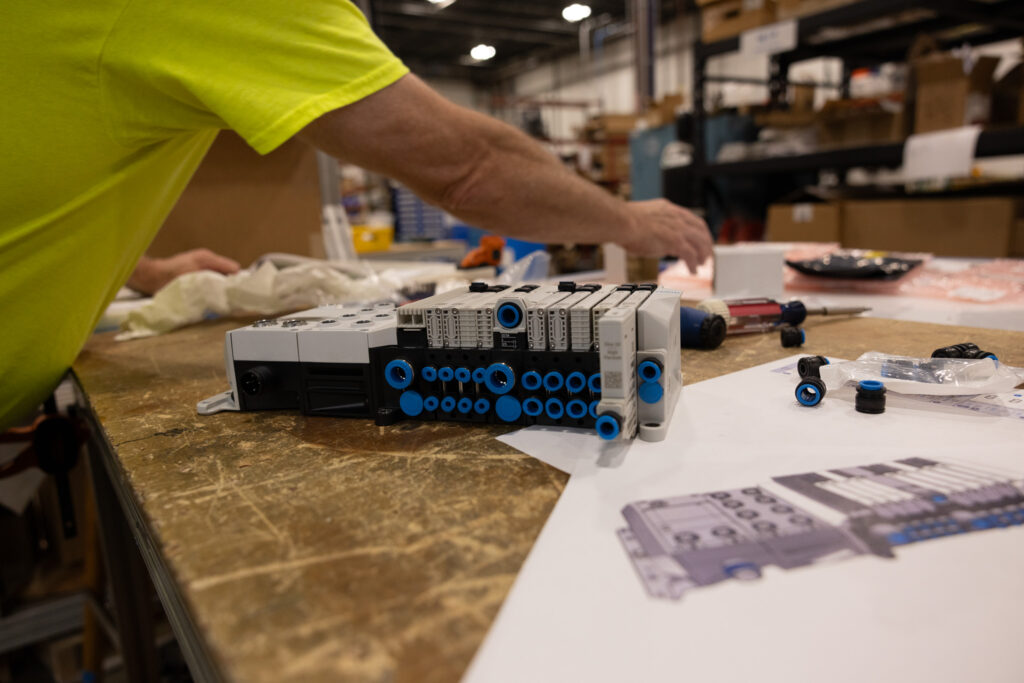
One of the defining characteristics of VTUX is its modular manifold system.
Different manifold sub-bases can be combined on the same terminal, allowing designers to accommodate different flow requirements while continuing to use the same valve platform.
Current VTUX documentation specifies flow rates of up to 690 l/min. The platform also supports manifold sub-bases for either individual valves or groups of four valves.
That means a machine does not necessarily need an oversized valve terminal simply because one pneumatic function requires more flow.
Why does that matter?
It allows an OEM to configure pneumatic performance around the individual application while maintaining greater component commonality across the machine.
That can simplify:
The VTUX supports substantial pneumatic control within a single platform.
Festo’s current technical documentation specifies configurations with up to 64 valve positions when using serial communication.
This makes VTUX suitable for applications ranging from relatively compact pneumatic assemblies to machines containing many automated functions.
And because the system uses a modular tie-rod design, terminals can be expanded or modified when machine requirements change.
Not every pneumatic function on a machine needs the same pressure.
The VTUX can support up to 16 pressure zones, depending on configuration. Additional supply modules allow separate sections of the terminal to operate at different pressure levels.
This can be particularly useful when one machine includes applications such as:
Instead of building completely separate valve systems, multiple requirements can potentially be addressed within one terminal architecture.
VTUX is not limited to positive-pressure pneumatic control.
Vacuum generation can be integrated directly into the manifold system. Festo’s VTUX vacuum platform can support multiple vacuum channels and includes features such as pressure sensing, ejector pulse control, vacuum monitoring, and configurable air-saving functions.
For machine builders using vacuum cups for handling, packaging, assembly, or robotic end-of-arm tooling, this can reduce the number of separate pneumatic components required around the machine.
It also brings vacuum information closer to the control system.
For example, monitored vacuum values can help determine whether a part has actually been picked before the machine proceeds to its next operation.
Pneumatics are only one part of modern machine architecture.
Sensors, grippers, switches, vacuum devices, and other automation components also need to communicate with the PLC.
VTUX can be combined with digital and analog I/O modules as well as Enlace IO, allowing pneumatic control and machine-level I/O to be incorporated into the same broader automation architecture.
That can reduce the amount of individual wiring returning to the main control cabinet.
VTUX can integrate with Festo’s CPX-AP-A y CPX-AP-I automation platforms.
CPX-AP-A is designed around centralized modular I/O, while CPX-AP-I enables decentralized I/O devices to be positioned around the machine.
With a decentralized architecture, valve terminals and I/O can be installed closer to actuators and sensors rather than routing every connection back to a central cabinet.
This approach can help reduce:
Festo also supports industrial communication protocols through the AP platform, including commonly used networks such as PROFINET and EtherNet/IP
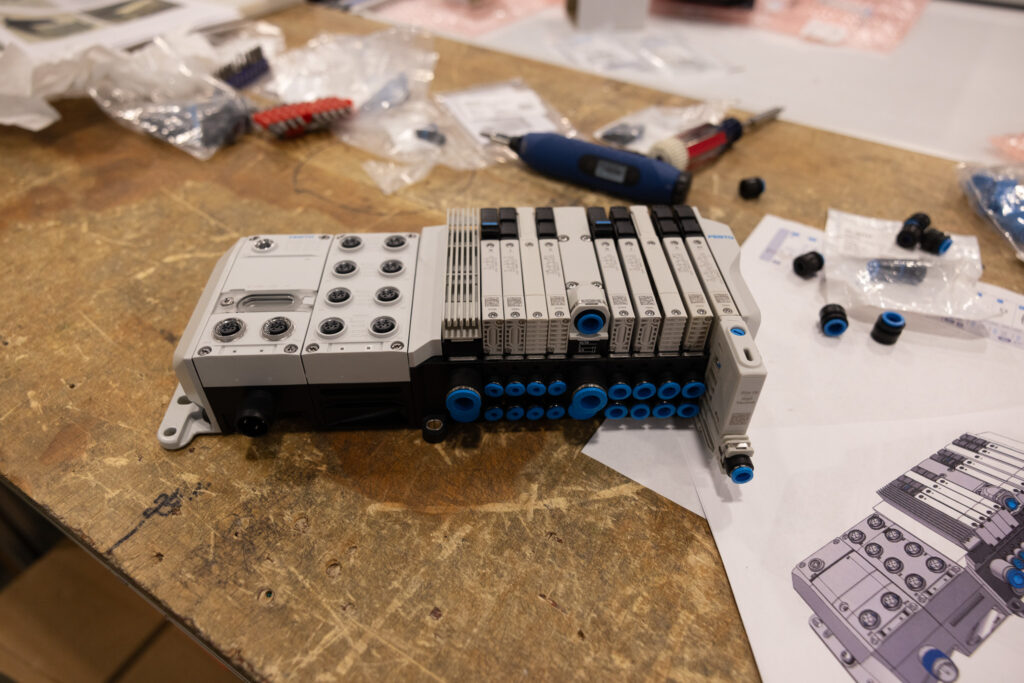
One important VTUX design decision is where the valve terminal should live.
Centralized architecture
A centralized design places pneumatic control closer to, or inside, the main control cabinet.
This may make sense when:
A decentralized system moves valve terminals and I/O closer to the devices they control.
This can be beneficial when:
VTUX is designed to support both approaches, allowing machine builders to select the architecture that makes sense for the actual equipment rather than being locked into one control strategy.
The real value of a modular valve terminal is not simply how many valves fit onto it.
It is how much engineering and machine complexity can potentially be consolidated.
Consider a machine requiring pneumatic valves, remote sensors, vacuum generation, multiple pressure zones, and communications.
Without an integrated architecture, that could require several different systems.
With VTUX, many of those functions can be designed into a common platform.
For OEMs building multiple machine models or repeatedly modifying equipment for different customers, standardizing around one configurable platform can also reduce the number of unique components engineering and purchasing teams need to manage.
Festo specifically positions VTUX modularity as a way to reduce inventory requirements while simplifying commissioning, troubleshooting, and repair.
VTUX can fit a wide range of factory automation applications, particularly where machines contain several pneumatic and electrical functions.
Potential applications include:
Its lightweight polymer construction can also be advantageous where overall equipment mass matters, including applications involving robotic tooling. Festo describes the material as mechanically robust enough for demanding environments such as welding cells.
There is no single standard VTUX configuration that works for every machine.
Before selecting a terminal, start with the application.
Important information includes:
Valve functions
How many pneumatic functions need to be controlled, and what valve configurations do they require?
Flow requirements
How much air does each pneumatic function need?
Operating pressure
Does the entire machine operate at the same pressure, or are multiple pressure zones required?
Vacuum requirements
Does the machine need vacuum generation, sensing, or ejector pulse control?
Communication protocol
How will the terminal communicate with the machine controller?
I/O requirements
How many digital, analog, or IO-Link devices need to be connected?
Machine architecture
Will the system be centralized or decentralized?
Future expansion
Is the machine likely to gain additional stations, valves, or sensors later?
Considering those details before specifying the terminal helps prevent both oversizing and building a configuration with no room to accommodate future changes.
For OEMs, standardization can be just as important as component performance.
Using one configurable valve-terminal family across multiple machine designs may allow engineering teams to create repeatable standards for:
The exact terminal may change from machine to machine, but the underlying platform remains familiar.
That can be especially useful for OEMs supporting equipment installed across multiple customer locations.
Selecting the terminal itself is only part of the process.
The valve functions, flow, pressure zones, communication method, I/O, vacuum requirements, tubing, fittings, actuators, and air preparation all have to work together.
PennAir is a Festo distributor, and our application engineering team helps customers select and size Festo pneumatic and automation components around real machine requirements.
If you’re evaluating VTUX for a new machine or considering a move from individually wired valves or an older valve-terminal platform, send us your pneumatic schematic, I/O requirements, or machine concept.
We can help determine what the terminal actually needs before you order it.
Puede ver cómo se configuró esta ventana emergente en nuestra guía paso a paso: https://wppopupmaker.com/guides/auto-opening-announcement-popups/
Puede ver cómo se configuró esta ventana emergente en nuestra guía paso a paso: https://wppopupmaker.com/guides/auto-opening-announcement-popups/
Puede ver cómo se configuró esta ventana emergente en nuestra guía paso a paso: https://wppopupmaker.com/guides/auto-opening-announcement-popups/
Puede ver cómo se configuró esta ventana emergente en nuestra guía paso a paso: https://wppopupmaker.com/guides/auto-opening-announcement-popups/
Puede ver cómo se configuró esta ventana emergente en nuestra guía paso a paso: https://wppopupmaker.com/guides/auto-opening-announcement-popups/
Puede ver cómo se configuró esta ventana emergente en nuestra guía paso a paso: https://wppopupmaker.com/guides/auto-opening-announcement-popups/
Puede ver cómo se configuró esta ventana emergente en nuestra guía paso a paso: https://wppopupmaker.com/guides/auto-opening-announcement-popups/
 Español de México
  English