

The CMMT multiprotocol hardware supports PROFINET, EtherCAT, EtherNet/IP, and Modbus TCP. This allows the drive to be configured for different industrial network environments without selecting a separate drive family for each supported protocol.
A single-turn encoder identifies the position within one motor revolution. A multi-turn encoder also tracks revolutions across multiple turns. In the video, Festo recommends the multi-turn option when an application needs to retain position through a power-down and avoid repeating the normal homing process.
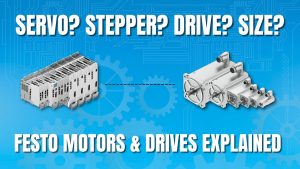
For demanding servo applications, the Festo CMMT-AS servo drive and EMMT-AS AC servo motor create an integrated motion-control system with precise positioning, multiprotocol connectivity, built-in safety options, absolute encoder feedback, and simplified one-cable motor connectivity.
For lower-power positioning applications, the compact CMMT-ST provides an alternative for controlling stepper motors, brushless DC motors, and EC motors using 24 or 48 V DC. Festo’s stepper motor options give machine builders additional flexibility when an application does not require the full performance of an AC servo system.
A motion-control system is more than a motor. The drive must communicate with the machine controller, regulate the motor, process feedback, execute the required motion profile, and support the application’s safety requirements.
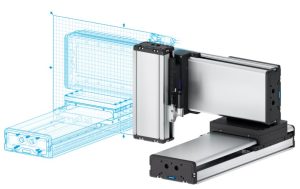
Festo approaches these requirements as a complete system. The CMMT-AS and EMMT-AS are designed to work together, while Festo’s broader portfolio adds actuators, mounting components, cables, controls, and engineering tools that help simplify the process of building a complete electric motion solution.
Key platform advantages include:
For demanding and dynamic positioning applications, the CMMT-AS servo drive and EMMT-AS AC synchronous servo motor form an integrated Festo servo solution.
The CMMT-AS is a scalable servo drive designed for precise force, speed, and position control. It can perform point-to-point positioning or interpolated movements, allowing the platform to support both straightforward positioning axes and more coordinated machine concepts.
The drive is available across a wide performance range. Depending on the selected drive variant, the CMMT-AS supports single-phase input from 100 to 230 V AC or three-phase input from 200 to 480 V AC.
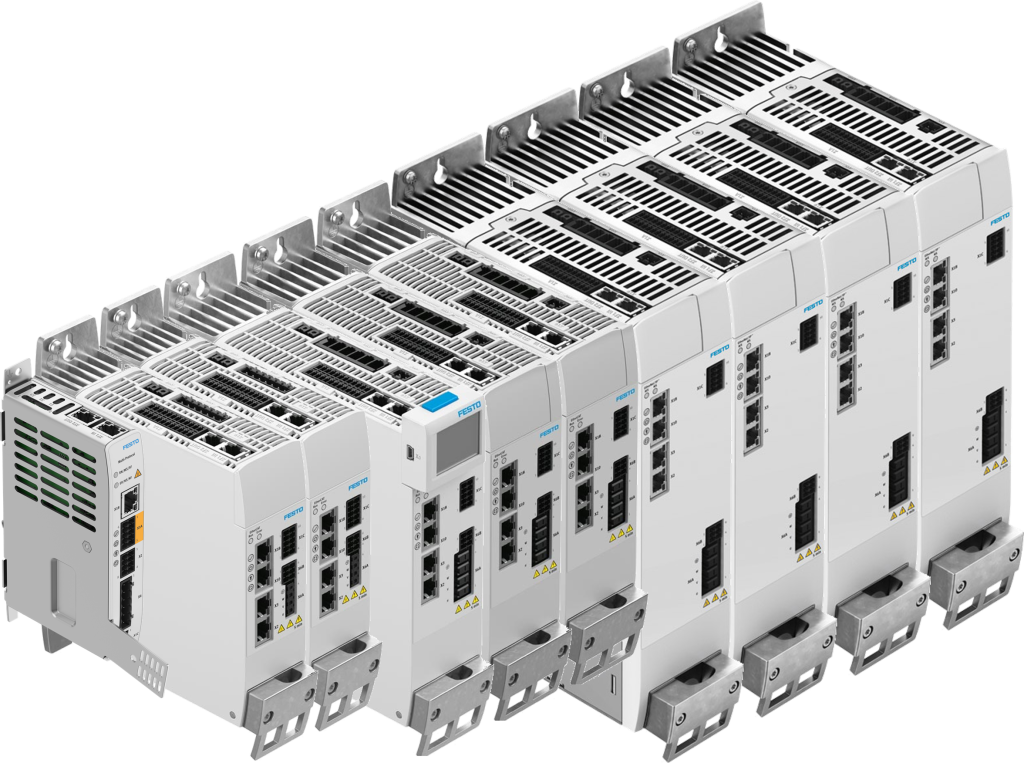
The drive configurations discussed in the video cover approximately 300 W through 12 kW.
One of the CMMT platform’s most useful features is its multiprotocol capability. PROFINET, EtherCAT, EtherNet/IP, and Modbus TCP are supported within the same multiprotocol drive hardware. This reduces the need to select an entirely different drive family solely because of the PLC or industrial network being used.
Festo also offers an optional removable color touchscreen display. As demonstrated in the video, the display can be moved between drives, used to review or clear errors, and used to transfer stored parameters from one drive to another.
The EMMT-AS is a brushless, permanently magnetized synchronous servo motor designed for demanding and dynamic positioning applications. Festo offers six motor sizes in multiple overall lengths, allowing the motor family to address a range of machine designs and performance requirements.
One of its most practical features is the one-cable plug. Instead of running separate cables for power, encoder feedback, and the optional holding brake, the connection combines these functions into one cable. This can reduce cable routing, simplify installation, and make motor replacement more straightforward.
The connection can also be rotated to accommodate different mounting positions and cable-routing requirements. Depending on the selected connector size, the EMMT-AS one-cable connection can rotate up to 290 or 310 degrees, providing flexibility for different mounting positions and cable-routing requirements.
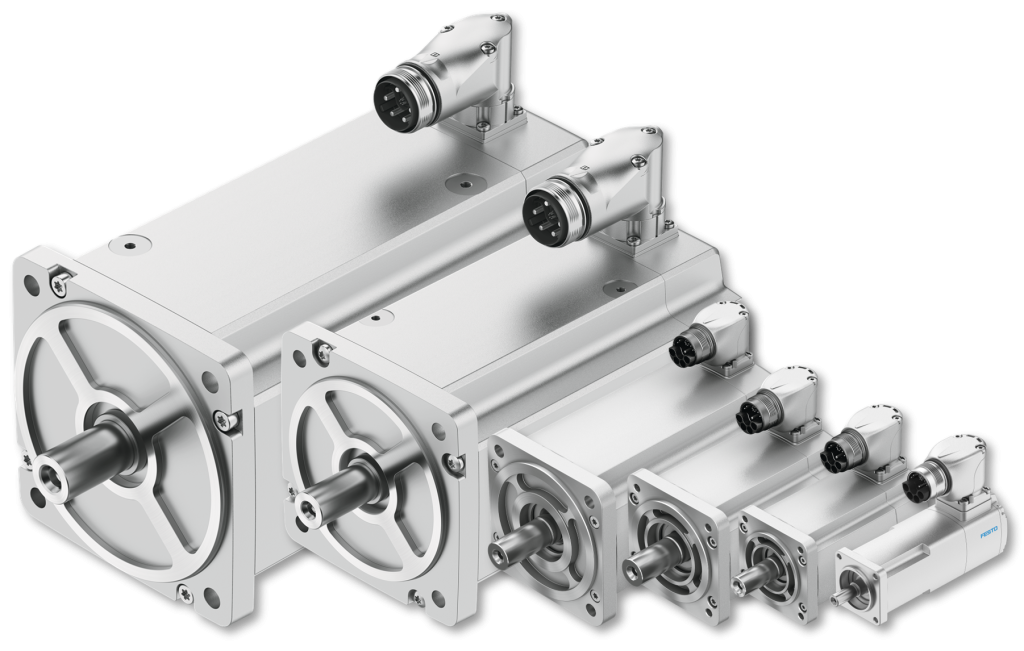
The EMMT-AS is available with:
The EMMT-AS also includes an electronic rating plate containing relevant motor data. The CMMT-AS can read this information and use it to set the corresponding motor parameters during commissioning.
The encoder configuration affects how the system tracks and retains position.
A single-turn absolute encoder identifies the motor’s position within one complete revolution. If the application powers down, the system may need to complete its normal homing process to reestablish the full machine position.
A multi-turn absolute encoder tracks the motor position across multiple revolutions. In the video, Festo explains that this option is useful when an application needs to retain position through a power cycle without repeating the normal homing process.
The right encoder depends on the machine’s mechanics, startup requirements, travel range, and expected behavior after power is removed.
Not every positioning application requires a full AC servo system. For axes with lower power requirements, the CMMT-ST offers a compact, extra-low-voltage alternative.
The CMMT-ST operates at 24 or 48 V DC and provides 150 W or 300 W of continuous power, depending on the supply voltage. It can control stepper motors, brushless DC motors, and EC motors. Like the larger CMMT-AS, it supports point-to-point and interpolated movements, multiprotocol communication, auto-tuning, and integrated safety functions.
Festo’s closed-loop stepper option, discussed in the video, is available in several NEMA sizes with absolute encoder feedback, single-turn and multi-turn configurations, an optional holding brake, and a rotatable one-cable connection.
For simpler positioning requirements, Festo also offers the EMMS-ST stepper motor family. Festo describes it as a long-life, two-phase hybrid stepper motor for applications with reduced requirements. An incremental encoder is available for closed-loop operation.
The final decision should not be based on motor type alone. Required torque, speed, positioning accuracy, duty cycle, load mechanics, environmental protection, control architecture, and future machine requirements all influence the right selection.
Functional safety is an important part of drive selection, particularly for machines with guarded access, service interaction, vertical loads, or coordinated motion.
The CMMT-AS is available with standard safety functions including Safe Torque Off (STO) and Safe Brake Control (SBC). Depending on the selected drive variant and safety configuration, additional functions may include Safe Stop 1 (SS1), Safe Stop 2 (SS2), Safely Limited Speed (SLS), Safe Maximum Speed (SMS), and Safe Operating Stop (SOS). Available functions, communication methods, and safety ratings vary by drive configuration.
The CMMT-ST includes Safe Torque Off (STO) and can support Safe Stop 1, time-controlled (SS1-t) when used with the required external safety switching device and suitable circuitry.
PennAir can help evaluate your motion requirements and identify an appropriate drive configuration while accounting for functional-safety needs during the selection process. Final safety architecture, risk assessment, and validation remain specific to the machine and application.
The CMMT-AS and EMMT-AS platform is suited for machines that require controlled position, speed, or torque.
Potential applications include:
Festo identifies applications ranging from high-speed manufacturing to precision dosing and delicate handling as examples for its servo motor and drive systems. Electric Motion Sizing also includes workflows for conveyors, ball-screw mechanisms, rack-and-pinion systems, index tables, press-fitting applications, and multi-axis handling systems.
PennAir helps customers evaluate the complete motion-control application, not just select an individual motor or drive. This creates a more coordinated path from initial requirements through component selection and system integration.
Our team can help: